It's time to Understanding Cross-Body Coordination Through the Spiral Line When you walk, a step forward with your left foot is usually matched by a swing of your right arm. When you look over your shoulder, swing a golf club or step across a gap, force does not stay in a single joint. Your ribcage, trunk, pelvis and limbs need to work together to rotate and transfer weight.
In some movement observations and training designs, TOBETTRA draws on the Anatomy Trains perspective of whole-body myofascial connections. One of its concepts, the Spiral Line, can help us understand how the two sides of the body relate to each other through opposite-side movement.
The Spiral Line is an observational model. It is not the name of a condition, and it cannot be used on its own to diagnose pain.
What Is the Spiral Line?
According to Anatomy Trains, the Spiral Line wraps around the body in opposing spiral paths. It runs from the head across the upper back to the opposite shoulder, wraps around the front of the ribcage and trunk to the hip, continues down the thigh and lower leg to the arch of the foot, then returns upward along the back and outer side of the leg to connect with the back.
The value of this model is not to blame every problem on one "fascial line". It reminds us that:
- Turning involves several joints working together
- Walking relies on opposite-side coordination between the upper and lower limbs
- Tightness in one area may relate to how other areas are controlling movement
- The same outward appearance can have different causes

Why Might Turning Feel Stuck?
Difficulty turning does not necessarily mean the Spiral Line is "out of balance". Possible factors include: Limited upper-back (thoracic) mobility Insufficient hip control; Unstable weight-bearing through the foot and ankle; Limited ability of the trunk to resist rotation; Protective responses to pain; Movement habits formed after a previous injury.
For this reason, simply checking whether the body looks asymmetrical is not enough. What matters more is how you distribute effort in real movement, for example:
- Whether you need to stop before turning when walking around a corner
- Whether the lower back does all the rotating during a golf swing
- Whether one shoulder and the opposite hip coordinate smoothly
- Whether you can control rotation under load rather than locking the body rigid
- Whether your pelvis and trunk sway excessively when stepping
How Does TOBETTRA Use This Perspective?
Observe the whole movement first.
We start with walking, stepping, turning, arm swing and weight transfer to understand where the limitation appears, rather than deciding in advance that a particular fascial line needs to be "released".
Then choose an appropriate approach.
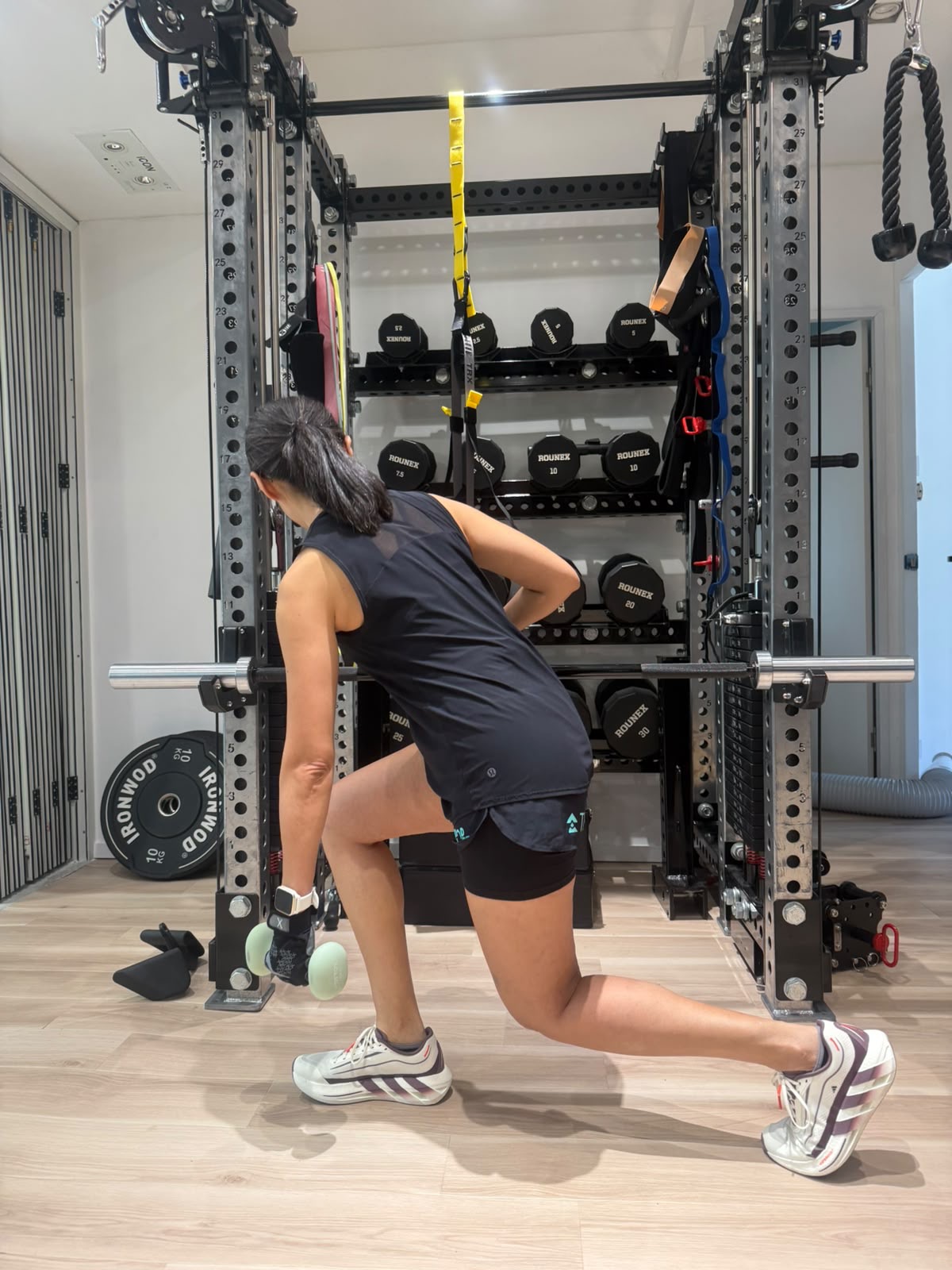
Training may include ribcage and hip mobility, opposite-side pushing and pulling, anti-rotation work, split stances, turning steps and multidirectional weight-bearing. Where suitable for the individual, one-to-one myofascial work may also be added to help the body feel more at ease and to create a more suitable starting point for active movement.
Assessment and management of pain are provided, according to individual needs, by a registered physiotherapist or a certified Anatomy Trains Structural Integration practitioner. The two have different professional scopes, and physiotherapy services are provided only by registered physiotherapists.
Finally, bring it back into daily life.
The real goal is not to "fix the Spiral Line". It is to help you coordinate your whole body more steadily when you glance at traffic while crossing the road, change direction on a hike, swing a club, pick up a bag or use stairs.
How Do We Measure Progress?
Depending on your goals, we may compare range of rotation, time taken to turn while walking, stability when stepping, differences in weight-bearing between the left and right sides, control during opposite-side pushing and pulling, and your own confidence. These measures need to be interpreted together with your symptoms and everyday performance, and they cannot be used as a medical diagnosis.
The Spiral Line offers one way of looking at connections across the body. What truly changes capability is an assessment and practice suited to you, together with consistent, progressive loading.
Important: This article is for general movement education only. The Spiral Line is a myofascial observation model and cannot replace the diagnosis of a doctor or registered physiotherapist. If you have radiating numbness or pain, persistent weakness, changes in bladder or bowel function, a recent fall or acute injury, please seek medical assessment first.